Free Downloadable Images Of Faith Hope Love
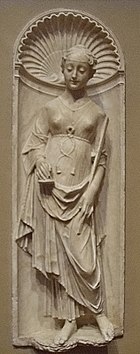
Faith, derived from Latin fides and Former French feid,[ane] is confidence or trust in a person, thing, or concept.[i] [2] In the context of organized religion, ane can define faith every bit "belief in God or in the doctrines or teachings of religion".[3] Religious people oft call up of faith as confidence based on a perceived degree of warrant,[4] [5] while others who are more skeptical of faith tend to retrieve of organized religion every bit simply belief without evidence.[6]
Etymology [edit]
The English word organized religion is idea to date from 1200–1250, from the Heart English feith, via Anglo-French fed, Old French feid, feit from Latin fidem, accusative of fidēs (trust), alike to fīdere (to trust).[7]
Stages of faith development [edit]
James W. Fowler (1940–2015) proposes a serial of stages of faith-evolution (or spiritual development) across the homo life-bridge. His stages chronicle closely to the work of Piaget, Erikson, and Kohlberg regarding aspects of psychological evolution in children and adults. Fowler defines faith as an activity of trusting, committing, and relating to the world based on a set up of assumptions of how one is related to others and the earth.[eight]
Stages of faith [edit]
- Intuitive-Projective: a stage of confusion and of loftier impressionability through stories and rituals (pre-school catamenia).
- Mythic-Literal: a phase where provided information is accustomed in guild to conform with social norms (schoolhouse-going period).
- Synthetic-Conventional: in this stage the faith caused is concreted in the belief system with the forgoing of personification and replacement with authorisation in individuals or groups that represent i'south beliefs (early-late adolescence).
- Individuative-Cogitating: in this phase the individual critically analyzes adopted and accustomed faith with existing systems of faith. Disillusion or strengthening of organized religion happens in this stage. Based on needs, experiences and paradoxes (early adulthood).
- Conjunctive faith: in this phase people realize the limits of logic and, facing the paradoxes or transcendence of life, have the "mystery of life" and frequently return to the sacred stories and symbols of the pre-acquired or re-adopted faith organization. This stage is chosen negotiated settling in life (mid-life).
- Universalizing faith: this is the "enlightenment" stage where the individual comes out of all the existing systems of religion and lives life with universal principles of pity and love and in service to others for upliftment, without worries and doubt (middle-late machismo (45–65 years sometime and plus).[nine] [ full citation needed ]
No difficult-and-fast rule requires individuals pursuing religion to go through all six stages. In that location is a high probability for individuals to be content and fixed in a particular stage for a lifetime; stages from 2–5 are such stages. Stage six is the summit of faith development. This state is ofttimes[ quantify ] considered every bit "not fully" accessible.[10]
Religious views [edit]
Baháʼí Faith [edit]
In the Baháʼí Faith, faith is meant, get-go, conscious knowledge, and second, the practice of good deeds,[11] ultimately the credence of the divine authority of the Manifestations of God.[12] In the religion's view, faith and knowledge are both required for spiritual growth.[12] Faith involves more than than outward obedience to this authority, just besides must be based on a deep personal understanding of religious teachings.[12]
Buddhism [edit]
Organized religion in Buddhism (Pali: saddhā , Sanskrit: śraddhā ) refers to a serene commitment in the do of the Buddha's didactics and trust in enlightened or highly developed beings, such equally Buddhas or bodhisattvas (those aiming to get a Buddha).[13] [14] Buddhists usually recognize multiple objects of faith, simply many are especially devoted to one particular object of faith, such equally one particular Buddha.[thirteen] [15] [xvi]
In early Buddhism, faith was focused on the Triple Gem, that is, Gautama Buddha, his didactics (the Dhamma), and the community of spiritually adult followers, or the monastic community seeking enlightenment (the Sangha). Although offerings to the monastic community were valued highest, early Buddhism did not morally condemn peaceful offerings to deities.[17] A faithful devotee was called upāsaka or upāsika, for which no formal declaration was required.[eighteen] In early Buddhism, personal verification was valued highest in attaining the truth, and sacred scriptures, reason or faith in a instructor were considered less valuable sources of say-so.[19] As important as faith was, it was a mere initial step to the path to wisdom and enlightenment, and was obsolete or redefined at the final stage of that path.[20] [21]
While faith in Buddhism does not imply "bullheaded faith", Buddhist do yet requires a caste of trust, primarily in the spiritual attainment of Gautama Buddha. Organized religion in Buddhism centers on the understanding that the Buddha is an Awakened beingness, on his superior role as teacher, in the truth of his Dharma (spiritual teachings), and in his Sangha (customs of spiritually developed followers). Faith in Buddhism can be summarised every bit faith in the 3 Jewels: the Buddha, Dharma and Sangha. It is intended to lead to the goal of enlightenment, or bodhi, and Nirvana. Volitionally, faith implies a resolute and courageous act of will. It combines the steadfast resolution that one volition do a thing with the cocky-confidence that one can do information technology.[22]
In the later stratum of Buddhist history, particularly Mahāyāna Buddhism, faith was given a much more of import role.[23] [24] The concept of the Buddha Nature was developed, as devotion to Buddhas and bodhisattvas residing in Pure Lands became commonplace.[25] [26] With the arising of the cult of the Lotus Sūtra, faith gained a fundamental function in Buddhist practise,[27] which was further amplified with the development of devotion to the Amitabha Buddha in Pure Land Buddhism.[28] [29] In the Japanese grade of Pure State Buddhism, nether the teachers Hōnen and Shinran, only entrusting faith toward the Amitabha Buddha was believed to exist a fruitful course of practice, as the practise of celibacy, morality and other Buddhist disciplines were dismissed as no longer effective in this day and age, or contradicting the virtue of faith.[30] [31] [32] Organized religion was defined as a state similar to enlightenment, with a sense of self-negation and humility.[33] [34]
Thus, the role of faith increased throughout Buddhist history. However, from the nineteenth century onward, Buddhist modernism in countries similar Sri Lanka and Nihon, and besides in the West, has downplayed and criticized the function of faith in Buddhism. Faith in Buddhism still has a role in modern Asia or the West, only is understood and defined differently from traditional interpretations.[35] [36] [37] Within the Dalit Buddhist Motion communities, taking refuge is defined not but as a religious, just also a political selection.[38]
Christianity [edit]
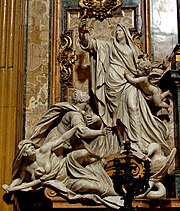
The word translated as "religion" in English language-linguistic communication editions of the New Testament, the Greek word πίστις (pístis), can also be translated equally "conventionalities", "faithfulness", or "trust".[39] Christianity encompasses diverse views regarding the nature of faith. Some see faith as being persuaded or convinced that something is true.[40] In this view, a person believes something when they are presented with acceptable show that it is true. The 13th-century theologian Saint Thomas Aquinas did not concord that religion is mere opinion: on the contrary, he held that information technology represents a hateful (understood in the Ideal sense) between excessive reliance on science (i.eastward. demonstration) and excessive reliance on stance.[41]
Numerous commentators discuss the results of religion. Some believe that true faith results in adept works, while others believe that while faith in Jesus brings eternal life, it does not necessarily result in proficient works.[42]
Regardless of the approach taken to faith, all Christians agree that the Christian faith (in the sense of Christian practise) is aligned with the ideals and the case of the life of Jesus. The Christian contemplates the mystery of God and his grace, and seeks to know and become obedient to God. To a Christian, the faith is not static[43] but causes one to learn more of God and to grow in organized religion; Christian faith has its origin in God.[44]
The definition of faith given by the author of the Epistle to the Hebrews at Hebrews 11:1 carries item weight with Christians who respect the Bible. There the author writes:
"Now faith is the substance of things hoped for, the evidence of things not seen." — King James Version
"At present faith is the assurance that what we hope for will come up well-nigh and the certainty that what nosotros cannot see exists." — International Standard Version
In Christianity, organized religion causes modify every bit it seeks a greater agreement of God. Organized religion is not only fideism or simple obedience to a set of rules or statements.[45] Before Christians have faith, they must understand in whom and in what they take faith. Without understanding, there cannot be true faith, and that understanding is built on the foundation of the customs of believers, the scriptures and traditions and on the personal experiences of the believer.[46] In English translations of the New Testament, the discussion "faith" generally corresponds to the Greek substantive πίστις (pistis) or to the Greek verb πιστεύω (pisteuo), significant "to trust, to have confidence, faithfulness, to be reliable, to assure".[47]
Strength of faith [edit]
Christians may recognise different degrees of faith when they encourage each other to and themselves strive to develop, abound, and/or deepen their faith.[48] This may imply that one can measure organized religion. Willingness to undergo martyrdom indicates a proxy for depth of religion, just does not provide an everyday measurement for the average contemporary Christian. Within the Calvinist tradition the degree of prosperity[49] may serve as an analog of level of faith.[50] Other Christian strands may rely on personal cocky-evaluation to measure the intensity of an individual's faith, with associated difficulties in calibrating to whatsoever scale. Solemn affirmations of a creed (a statement of faith) provide broad measurements of details. Various tribunals of the Inquisition, nonetheless, concerned themselves with precisely evaluating the orthodoxy of the faith of those it examined – in order to deport or to punish in varying degrees.[51]
The classification of different degrees of faith allows that faith and its expression may wax and wane in fervor - during the lifetime of a faithful private and/or over the various historical centuries of a order with an embedded religious arrangement. Thus one can speak of an "Age of Faith"[52] [53] or of the "disuse" of a society'southward religiosity into corruption,[54] secularism,[55] or atheism,[56] - interpretable as the ultimate loss of religion.[57]
Christian apologetic views [edit]
In contrast to Richard Dawkins' view of faith equally "blind trust, in the absence of testify, even in the teeth of evidence",[58] Alister McGrath quotes the Oxford Anglican theologian W. H. Griffith Thomas (1861–1924), who states that organized religion is "not blind, only intelligent" and that it "commences with the confidence of the mind based on adequate show...", which McGrath sees as "a adept and reliable definition, synthesizing the core elements of the feature Christian understanding of faith".[59]
American biblical scholar Archibald Thomas Robertson (1863-1934) stated that the Greek give-and-take pistis used for "faith" in the New Attestation (over two hundred twoscore times), and rendered "assurance" in Acts 17:31 (KJV), is "an old verb significant "to furnish", used regularly past Demosthenes for bringing forward evidence."[60] Tom Price (Oxford Centre for Christian Apologetics) affirms that when the New Attestation talks about faith positively it only uses words derived from the Greek root [pistis] which ways "to be persuaded".[61]
British Christian apologist John Lennox argues that "organized religion conceived as belief that lacks warrant is very different from organized religion conceived as conventionalities that has warrant". He states that "the use of the adjective 'blind' to draw 'faith' indicates that faith is not necessarily, or always, or indeed normally, blind". "The validity, or warrant, of religion or conventionalities depends on the strength of the evidence on which the belief is based." "We all know how to distinguish betwixt bullheaded religion and show-based faith. We are well enlightened that faith is merely justified if there is evidence to back it upwards." "Evidence-based religion is the normal concept on which nosotros base our everyday lives."[62]
Peter S Williams[63] holds that "the classic Christian tradition has always valued rationality, and does non hold that organized religion involves the consummate abandonment of reason while believing in the teeth of evidence".[ page needed ] Quoting Moreland, religion is defined every bit "a trust in and commitment to what we have reason to believe is true".[ commendation needed ]
Regarding doubting Thomas in John 20:24–31, Williams points out that "Thomas wasn't asked to believe without evidence". He was asked to believe on the basis of the other disciples' testimony. Thomas initially lacked the first-mitt experience of the show that had convinced them... Moreover, the reason John gives for recounting these events is that what he saw is testify... Jesus did many other miraculous signs in the presence of his disciples...But these are written that yous may believe that Jesus is the Christ, the son of God, and that believing ye might have life in his name. John xx:30,31.[64]
Concerning doubting Thomas, Michael R. Allen wrote: "Thomas's definition of faith implies adherence to conceptual propositions for the sake of personal knowledge, knowledge of and about a person qua person".[65]
Kenneth Boa and Robert One thousand. Bowman Jr. describe a classic understanding of faith that is referred to[ by whom? ] as evidentialism, and which is role of a larger epistemological tradition chosen classical foundationalism, which is accompanied past deontologism, which holds that humans have an obligation to regulate their beliefs in accordance with evidentialist structures.
They bear witness how this can get too far,[66] and Alvin Plantinga deals with it. While Plantinga upholds that organized religion may be the issue of evidence testifying to the reliability of the source (of the truth claims), yet he sees having faith as being the result of hearing the truth of the gospel with the internal persuasion by the Holy Spirit moving and enabling him to believe. "Christian conventionalities is produced in the laic past the internal instigation of the Holy Spirit, endorsing the teachings of Scripture, which is itself divinely inspired by the Holy Spirit. The result of the work of the Holy Spirit is organized religion."[67]
Catholicism [edit]
The four-function Canon of the Cosmic Church (CCC) gives Part One to "The Profession of Faith". This section describes the content of organized religion. It elaborates and expands particularly upon the Apostles' Creed. CCC 144 initiates a section on the "Obedience of Faith".
In the theology of Pope John Paul Ii, faith is understood in personal terms as a trusting commitment of person to person and thus involves Christian commitment to the divine person of Jesus Christ.[68]
Methodism [edit]
In Methodism, faith plays an important office in justification, which occurs during the New Nascence.[69] The Emmanuel Clan, a Methodist denomination in the bourgeois holiness motility, teaches:[lxx]
Living religion is the gift of God (Ephesians two:8; Romans 4:16) imparted to the obedient heart through the Give-and-take of God (Romans ten:17), and the ministry of the Holy Ghost (Ephesians 2:xviii). This faith becomes constructive as it is exercised by man with the aid of the Spirit, which assistance is always bodacious when the heart has met the divine condition (Hebrews v:9). Living faith is to be distinguished from intellectual conviction which may exist in the possession of any unawakened soul (Romans 10:1–four).―Principles of Organized religion, Emmanuel Association of Churches[70]
The Church of Jesus Christ of Latter-day Saints [edit]
The Articles of Religion of The Church of Jesus Christ of Latter-day Saints (LDS Church) states that "faith in the Lord Jesus Christ" is the first principle of the gospel.
Some culling, yet impactful, ideas regarding the nature of religion were presented by church founder Joseph Smith[71] in a collection of sermons, which are now published equally the Lectures on Faith.[72]
- Lecture ane explains what organized religion is;
- Lecture 2 describes how mankind comes to know almost God;
- Lectures 3 and four make clear the necessary and unchanging attributes of God;
- Lecture 5 deals with the nature of God the Father, his Son Jesus Christ, and the Holy Ghost;
- Lecture 6 proclaims that the willingness to sacrifice all earthly things is prerequisite to gaining faith unto salvation;
- Lecture vii treats the fruits of faith—perspective, power, and somewhen perfection.[73] [ date missing ]
Hinduism [edit]
Bhakti (Sanskrit: भक्ति) literally ways "attachment, participation, fondness for, homage, religion, love, devotion, worship, purity".[74] It was originally used in Hinduism, referring to devotion and beloved for a personal god or a representational god by a devotee.[75] [76] In ancient texts such as the Shvetashvatara Upanishad, the term simply ways participation, devotion and beloved for any endeavor, while in the Bhagavad Gita, it connotes one of the possible paths of spirituality and towards moksha, as in bhakti marga.[77]
Ahimsa, as well referred to equally nonviolence, is the fundamental tenet of Hinduism which advocates harmonious and peaceful co-existence and evolutionary growth in grace and wisdom for all humankind unconditionally.
In Hinduism, most of the Vedic prayers begins with the chants of Om. Om is the Sanskrit symbol that amazingly resonates the peacefulness ensconced within one's higher self. Om is considered to have a profound consequence on the body and mind of the one who chants and also creates a calmness, serenity, healing, strength of its own to prevail within and also in the surrounding environment.
Islam [edit]
In Islam, a believer's faith in the metaphysical aspects of Islam is called Iman (Arabic: الإيمان ), which is complete submission to the will of God, not unquestionable or blind conventionalities.[78] [79] A homo must build his faith on well-grounded convictions beyond whatsoever reasonable doubt and above uncertainty.[80] According to the Quran, Iman must be accompanied by righteous deeds and the two together are necessary for entry into Paradise.[81] In the Hadith of Gabriel, Iman in add-on to Islam and Ihsan grade the three dimensions of the Islamic organized religion.
Muhammad referred to the 6 axioms of faith in the Hadith of Gabriel: "Iman is that yous believe in God and His Angels and His Books and His Messengers and the Future and the good and evil fate [ordained past your God]."[82] The first 5 are mentioned together in the Qur'an[83] The Quran states that faith can abound with remembrance of God.[84] The Qur'an also states that naught in this earth should be dearer to a truthful believer than organized religion.[85]
Judaism [edit]
Judaism recognizes the positive value of Emunah [86] (more often than not translated as faith, trust in God) and the negative status of the Apikorus (heretic), simply faith is non as stressed or every bit central as it is in other religions, especially compared with Christianity and Islam.[87] Information technology could exist a necessary means for existence a practicing religious Jew, just the emphasis is placed on true knowledge, truthful prophecy and practise rather than on faith itself. Very rarely does information technology relate to any pedagogy that must be believed.[88] Judaism does not require one to explicitly identify God (a cardinal tenet of Christian faith, which is chosen Avodah Zarah in Judaism, a minor form of idol worship, a big sin and strictly forbidden to Jews). Rather, in Judaism, 1 is to honour a (personal) idea of God, supported by the many principles quoted in the Talmud to define Judaism, generally by what it is not. Thus at that place is no established formulation of Jewish principles of faith which are mandatory for all (observant) Jews.
In the Jewish scriptures, trust in God – Emunah – refers to how God acts toward his people and how they are to answer to him; it is rooted in the everlasting covenant established in the Torah, notably[88] Deuteronomy vii:9:
Know therefore that the LORD thy God, He is God; the faithful God, who keepeth covenant and mercy with them that love Him and keep His commandments to a thousand generations;[89]
The specific tenets that compose required belief and their awarding to the times have been disputed throughout Jewish history. Today many, just not all, Orthodox Jews accept accepted Maimonides' 13 Principles of Conventionalities.[91] [92]
A traditional example of Emunah equally seen in the Jewish annals is found in the person of Abraham. On a number of occasions, Abraham both accepts statements from God that seem impossible and offers obedient actions in response to direction from God to do things that seem implausible.[93]
"The Talmud describes how a thief also believes in 1000‑d: On the brink of his forced entry, as he is about to risk his life—and the life of his victim—he cries out with all sincerity, 'G‑d help me!' The thief has organized religion that in that location is a Thou‑d who hears his cries, nevertheless it escapes him that this G‑d may be able to provide for him without requiring that he abrogate Yard‑d'due south volition by stealing from others. For emunah to affect him in this way he needs study and contemplation."[86]
Sikhism [edit]
Religion itself is not a religious concept in Sikhism. Still, the five Sikh symbols, known as Kakaars or Five Ks (in Punjabi known as pañj kakkē or pañj kakār), are sometimes referred to as the V manufactures of Faith. The articles include kēs (uncut hair), kaṅghā (small wooden rummage), kaṛā (circular steel or iron bracelet), kirpān (sword/dagger), and kacchera (special undergarment). Baptised Sikhs are bound to wear those 5 articles of faith, at all times, to save them from bad company and continue them shut to God.[94]
Epistemological validity [edit]
In that location is a wide spectrum of opinion with respect to the epistemological validity of religion[95] - that is, whether it is a reliable fashion to acquire true beliefs.
Fideism [edit]
Fideism is an epistemological theory which maintains that faith is independent of reason, or that reason and faith are hostile to each other and faith is superior at arriving at particular truths (see natural theology). Fideism is not a synonym for religious belief, but describes a particular philosophical proposition in regard to the human relationship betwixt faith's appropriate jurisdiction at arriving at truths, assorted confronting reason. It states that faith is needed to decide some philosophical and religious truths, and it questions the power of reason to arrive at all truth. The discussion and concept had its origin in the mid- to late-19th century by way of Catholic thought, in a motility called Traditionalism. The Roman Cosmic Magisterium has, however, repeatedly condemned fideism.[96]
Support [edit]
Religious epistemologists accept formulated and defended reasons for the rationality of accepting conventionalities in God without the support of an argument.[97] Some religious epistemologists hold that belief in God is more than analogous to belief in a person than conventionalities in a scientific hypothesis. Human relations demand trust and commitment. If belief in God is more than like belief in other persons, then the trust that is appropriate to persons will be advisable to God. American psychologist and philosopher William James offers a similar argument in his lecture The Volition to Believe. [97] [98] Foundationalism is a view almost the structure of justification or knowledge.[99] Foundationalism holds that all knowledge and justified belief are ultimately based upon what are called properly basic beliefs. This position is intended to resolve the infinite regress problem in epistemology. Co-ordinate to foundationalism, a belief is epistemically justified only if it is justified by properly bones beliefs. 1 of the pregnant developments in foundationalism is the rise of reformed epistemology.[99]
Reformed epistemology is a view well-nigh the epistemology of religious belief, which holds that belief in God tin be properly basic. Analytic philosophers Alvin Plantinga and Nicholas Wolterstorff develop this view.[100] Plantinga holds that an individual may rationally believe in God even though the private does not possess sufficient prove to convince an doubter. One difference between reformed epistemology and fideism is that the old requires defence confronting known objections, whereas the latter might dismiss such objections as irrelevant.[101] Plantinga has developed reformed epistemology in Warranted Christian Conventionalities as a form of externalism that holds that the justification conferring factors for a belief may include external factors.[102] Some theistic philosophers have dedicated theism by granting evidentialism but supporting theism through deductive arguments whose premises are considered justifiable. Some of these arguments are probabilistic, either in the sense of having weight but existence inconclusive, or in the sense of having a mathematical probability assigned to them.[97] Notable in this regard are the cumulative arguments presented by British philosopher Basil Mitchell and analytic philosopher Richard Swinburne, whose arguments are based on Bayesian probability.[103] [104] In a notable exposition of his arguments, Swinburne appeals to an inference for the best explanation.[105] [106]
Professor of Mathematics and philosopher of scientific discipline at University of Oxford John Lennox has stated, "Religion is not a leap in the dark; it'southward the verbal opposite. It'south a commitment based on evidence… It is irrational to reduce all faith to blind faith and then subject it to ridicule. That provides a very anti-intellectual and convenient way of avoiding intelligent discussion." He criticises Richard Dawkins as a famous proponent of asserting that organized religion equates to holding a belief without evidence, thus that information technology is possible to hold conventionalities without show, for failing to provide evidence for this exclamation.[107] [ description needed ]
Criticism [edit]
Bertrand Russell wrote:[6]
Christians concord that their faith does good, only other faiths do damage. At any rate, they agree this near the communist religion. What I wish to maintain is that all faiths exercise harm. We may define "organized religion" as a business firm belief in something for which at that place is no bear witness. Where there is show, no one speaks of "religion." We practise not speak of religion that two and two are four or that the earth is round. We only speak of organized religion when we wish to substitute emotion for testify. The substitution of emotion for bear witness is apt to lead to strife, since different groups substitute unlike emotions. Christians take faith in the Resurrection; communists have faith in Marx's Theory of Value. Neither religion can be defended rationally, and each therefore is dedicated by propaganda and, if necessary, past war.
—Will Religious Organized religion Cure Our Troubles?
Evolutionary biologist Richard Dawkins criticizes all organized religion by generalizing from specific faith in propositions that conflict directly with scientific bear witness.[108] He describes faith as belief without bear witness; a process of active non-thinking. He states that it is a practice that but degrades our understanding of the natural world past assuasive anyone to make a claim about nature that is based solely on their personal thoughts, and possibly distorted perceptions, that does not require testing confronting nature, has no ability to make reliable and consistent predictions, and is not subject area to peer review.[109]
Philosophy professor Peter Boghossian argues that reason and evidence are the simply way to determine which "claims about the globe are likely true". Unlike religious traditions make different religious claims, and Boghossian asserts that religion alone cannot resolve conflicts betwixt these without evidence. He gives equally an example of the belief held by that Muslims that Muhammad (who died in the year 632) was the concluding prophet, and the contradictory conventionalities held past Mormons that Joseph Smith (born in 1805) was a prophet. Boghossian asserts that faith has no "built-in cosmetic mechanism". For factual claims, he gives the case of the conventionalities that the Earth is 4,000 years quondam. With just organized religion and no reason or evidence, he argues, there is no style to correct this merits if information technology is inaccurate. Boghossian advocates thinking of religion either as "belief without evidence" or "pretending to know things you don't know".[110]
Friedrich Nietzsche expressed his criticism of the Christian thought of faith in passage 51 of The Antichrist:[111]
The fact that faith, under sure circumstances, may work for blessedness, but that this blessedness produced by an idée fixe by no means makes the idea itself truthful, and the fact that faith actually moves no mountains, simply instead raises them up where there were none before: all this is made sufficiently clear by a walk through a lunatic aviary. Non, of grade, to a priest: for his instincts prompt him to the lie that sickness is non sickness and lunatic asylums not lunatic asylums. Christianity finds sickness necessary, merely as the Greek spirit had need of a superabundance of health—the actual ulterior purpose of the whole system of conservancy of the church is to make people ill. And the church building itself—doesn't it fix a Catholic lunatic asylum as the ultimate ideal?—The whole globe equally a madhouse?—The sort of religious homo that the church wants is a typical décadent; the moment at which a religious crisis dominates a people is always marked by epidemics of nervous disorder; the "inner world" of the religious man is and so much similar the "inner world" of the overstrung and wearied that information technology is difficult to distinguish between them; the "highest" states of mind, held upwards before mankind by Christianity as of supreme worth, are actually epileptoid in course—the church has granted the name of holy only to lunatics or to gigantic frauds in majorem dei honorem....
Run into also [edit]
- Bluish skies inquiry
- Delusion
- Dogma
- Organized religion and rationality
- Incorrigibility
- Life opinion
- Major religious groups
- Numinous
- Pascal'southward wager
- Piety
- Rationalism
- Religious conversion
- Saint Organized religion
- Simple church
- Spectrum of theistic probability
- Theological virtues
- There are no atheists in foxholes
- Truthiness
- Worldview
References [edit]
- ^ a b "Definition of religion in English language". Oxford Living Dictionaries. Oxford University Press. Retrieved March 1, 2019.
- ^ "Pregnant of organized religion in English". Cambridge Dictionary. Cambridge University Printing. Retrieved March one, 2019.
- ^ Compare: "Dictionary.com". world wide web.dictionary.com. Dictionary.com, LLC. 2018. Retrieved 2018-05-01 .
organized religion [...] substantive [...] iii. conventionalities in God or in the doctrines or teachings of faith [...]
- ^ Plantinga, Alvin (Jan 27, 2000). Warranted Christian Conventionalities. USA: Oxford University Press. pp. 169–199. ISBN978-0-19-513192-five . Retrieved November 27, 2019.
- ^ Boa, Kenneth (March 1, 2006). Organized religion Has Its Reasons: Integrative Approaches to Defending the Christian Faith. U.s.a.: IVP Books. pp. 251–255. ISBN978-0-8308-5648-0.
- ^ a b Russell, Bertrand. "Will Religious Organized religion Cure Our Troubles?". Human being Gild in Ethics and Politics. Ch vii. Pt 2. Retrieved xvi August 2009.
- ^ "Faith – Define Faith". Dictionary.com . Retrieved 14 October 2015.
- ^ Evans, Nancy; Forney, Deanna; Guido, Florence; Patton, Lori; Renn, Kristen (2010). Student Development in College: Theory, Enquiry, and Practice (2nd ed.). Jossey-Bass. ISBN978-0787978099.
- ^ Works of Daniel J. Levinson
- ^ Fowler, J.W.; Stages of Religion – The Psychology of Human being Development and the Quest for Meaning
- ^ "The Bahá'í Community of Canada". www.bahai.ca . Retrieved 2022-02-22 .
- ^ a b c Smith, P. (1999). A Curtailed Encyclopedia of the Baháʼí Organized religion. Oxford, UK: Oneworld Publications. p. 155. ISBN1-85168-184-1.
- ^ a b Gómez, Luis O. (2004). "Faith" (PDF). In Buswell, Robert Eastward. (ed.). Encyclopedia of Buddhism. New York [u.a.]: Macmillan Reference Usa, Thomson Gale. pp. 277–9. ISBN0-02-865720-nine.
- ^ Jayatilleke 1963, pp. 388–9.
- ^ Kinnard, Jacob Northward. (2004). "Worship" (PDF). In Buswell, Robert E. (ed.). Encyclopedia of Buddhism. New York [u.a.]: Macmillan Reference USA, Thomson Gale. p. 907. ISBN0-02-865720-9.
- ^ Jayatilleke 1963, pp. 386, 396–seven.
- ^ Lamotte 1988, pp. 74–5, 81.
- ^ Tremblay, Xavier (2007). "The spread of Buddhism in Serindia". In Heirman, Ann; Bumbacher, Stephan Peter (eds.). The spread of Buddhism (online ed.). Leiden: Brill Publishers. p. 87. ISBN9789004158306.
- ^ Fuller, Paul (2004). The notion of diṭṭhi in Theravāda Buddhism : the indicate of view. London: RoutledgeCurzon. p. 36. ISBN0-203-01043-four. [ dead link ]
- ^ Lamotte 1988, pp. 49–50.
- ^ Jayatilleke 1963, pp. 384, 396–vii.
- ^ Conze, Edward (1993). The Way of Wisdom The Five Spiritual Faculties. world wide web.accesstoinsight.org. Buddhist Publication Guild. ISBN978-9552401107.
- ^ Harvey 2013, p. 172.
- ^ Leaman, Oliver (2000). Eastern philosophy: cardinal readings (PDF). London [u.a.]: Routledge. p. 212. ISBN0-415-17357-4. Archived from the original (PDF) on 2015-05-15.
- ^ Bielefeldt, Carl (2004). "Japan" (PDF). In Buswell, Robert E. (ed.). Encyclopedia of Buddhism. New York [u.a.]: Macmillan Reference Usa, Thomson Gale. pp. 389–90. ISBN0-02-865720-nine.
- ^ Reynolds, Frank Eastward.; Hallisey, Charles (1987). "Buddha" (PDF). In Jones, Lindsay (ed.). Encyclopedia of faith. Vol. 2 (2nd ed.). Detroit: Thomson Gale. p. 1068. ISBN0-02-865997-Ten. Archived from the original on 2017-03-02.
{{cite encyclopedia}}: CS1 maint: bot: original URL status unknown (link) - ^ Shields, James Marking (2013). "Political Interpretations of the Lotus Sūtra" (PDF). In Emmanuel, Steven Grand. (ed.). A companion to Buddhist philosophy. Chichester, Westward Sussex: Wiley-Blackwell. pp. 512, 514. ISBN978-0-470-65877-2.
- ^ Hsieh, Ding-hwa (2009). "Buddhism, Pure Land". In Cheng, Linsun; Brown, Kerry (eds.). Berkshire encyclopedia of Mainland china. Bully Barrington, MA: Berkshire Publishing Grouping. pp. 236–7. ISBN978-0-9770159-iv-viii.
- ^ Green 2013, p. 123.
- ^ Light-green 2013, pp. 122–three.
- ^ Harvey 2013, pp. 230, 255.
- ^ Hudson, Clarke (2005). "Buddhist meditation: Due east Asian Buddhist meditation" (PDF). In Jones, Lindsay (ed.). Encyclopedia of faith. Vol. two (2nd ed.). Detroit: Thomson Gale. p. 1294. ISBN0-02-865997-X. Archived from the original on 2017-03-02.
{{cite encyclopedia}}: CS1 maint: bot: original URL status unknown (link) - ^ Conze, Edward (2003) [1951]. Buddhism, its essence and development. Mineola, N.Y.: Dover Publications. p. 158. ISBN0-486-43095-2. Archived from the original on 2017-xi-22. Retrieved 2017-11-twenty .
- ^ Dobbins, James C. (2002). Jodo Shinshu: Shin Buddhism in medieval Nihon. Honolulu: Academy of Hawaii Press. pp. 34–5. ISBN0-8248-2620-v.
- ^ Harvey 2013, pp. 378, 429, 444.
- ^ Gombrich, Richard F. (2006). Theravāda Buddhism: a social history from ancient Benares to modern Colombo (PDF) (2nd ed.). London [u.a.]: Routledge. pp. 196–7. ISBN0-415-36508-2. Archived from the original (PDF) on 2017-11-17. Retrieved 2017-11-20 .
- ^ Ahn, Juhn (2004). "Popular conceptions of Zen" (PDF). In Buswell, Robert E. (ed.). Encyclopedia of Buddhism. New York [u.a.]: Macmillan Reference USA, Thomson Gale. p. 924. ISBN0-02-865720-9.
- ^ Dore, Bhavya (ane October 2016). "Ascent degree-related violence pushes many Indians to new organized religion". Houston Chronicle. Organized religion News Service. Hearst Newspapers. Retrieved 23 September 2017.
- ^ "Strong's Greek: 4102. πίστις (pistis) – organized religion, faithfulness". biblehub.com . Retrieved 14 October 2015.
- ^ Wilkin, Robert N. (2012). The 10 Most Misunderstood Words in the Bible. Corinth, TX: GES. p. 221.
- ^ "SUMMA THEOLOGIAE: Faith (Secunda Secundae Partis, Q. i)". www.newadvent.org.
- ^ "(PDF) Jeremy Myers, The Gospel Under Siege: 3 Views on the Relationship Between Religion and Skillful Works" (PDF).
- ^ Lawler, Ronald David; Wuerl, Donald W.; Lawler, Thomas Comerford, eds. (1991) [1976]. The Teaching of Christ: A Cosmic Catechism for Adults. Volume 850 of O[ur] Due south[unday] V[isitor] (3 ed.). Huntington, Indiana: Our Sunday Visitor Pub. Sectionalisation. p. ii. ISBN9780879738501 . Retrieved 28 October 2021.
[...] the conviction that the faith is not a decision from academic researches and human reflections only a 'given,' no static 'deposit of the religion,' simply a dynamic message given by God Himself through Christ to the church, to be lived not in a departmentalized way but integrally [...].
- ^ Wuerl, Donald Westward. (2004). The Teaching of Christ: A Catholic Catechism for Adults, Edition: five, revised. Huntingdon, IN: Our Sunday Company Pub. Division. p. 238. ISBNone-59276-094-five . Retrieved 21 April 2009. [ dead link ]
- ^ Migliore, Daniel L. 2004. Faith seeking understanding: an introduction to Christian theology. Chiliad Rapids, Mich: W.B. Eerdmans. pp. 3–8.
- ^ Inbody, Tyron. 2005. The faith of the Christian church building: an introduction to theology. Grand Rapids, Mich: William B. Eerdmans Pub. pp. ane–10
- ^ Thomas, Robert L.; Editor, General (1981). New American standard exhaustive concordance of the Bible. Nashville, Tenn.: A.J. Holman. pp. 1674–75. ISBN0-87981-197-8.
- ^ For example: Draw Near to God: 100 Bible Verses to Deepen Your Organized religion. Zondervan. 2019. ISBN9780310453888 . Retrieved 25 September 2019.
- ^ Compare prosperity theology.
- ^ Compare: Weber, Max (1905). The Protestant Ethic and the 'Spirit' of Commercialism: and Other Writings. Penguin twentieth-century classics. Translated by Baehr, Peter; Wells, Gordon C. New York: Penguin (published 2002). ISBN9781101098479 . Retrieved 25 September 2019.
In the course of its development, Calvinism made a positive addition: the idea of the necessity of putting one's faith to the exam [Bewährung des Glaubens] in secular working life. [...] It thus provided the positive motivation [Antrieb] for asceticism, and with the firm establishment of its ethics in the doctrine of predestination, the spiritual aristocracy of the monks, who stood exterior and to a higher place the world, was replaced by the spiritual aristocracy of the saints in the world, predestined by God from eternity [...].
- ^ Peters, Edward (1988). "The Inquisition in Literature and Fine art". Inquisition (reprint ed.). Berkeley: Academy of California Press (published 1989). p. 225. ISBN9780520066304 . Retrieved 25 September 2019.
The costuming of those convicted [...] was the outcome of conscientious planning and indicated specific gradations of guilt. At that place was never a single, simple sanbenito, for example, merely a different kind of sanbenito for different crimes and degrees of heresy, with corresponding headgear [...]. The garb of the penitents, the procession with inquisitorial banners and crosses, the careful design of the seating and sequence of the ceremony made the motorcar-de-fé itself 'a work of art [...]' [...]. [...] The aim of the machine-de-fé, as its name suggests, is the 'deed of faith,' that is, the liturgical sit-in of the truth of the organized religion and the mistake and evil of its enemies.
- ^ Tanner, Norman (2009). The Ages of Faith: Pop Religion in Tardily Medieval England and Western Europe. Book 56 of International Library of Historical Studies. Bloomsbury Academic. p. 161. ISBN9781845117603 . Retrieved 28 October 2021.
After all, was non the Center Ages the 'age of religion' par execellence, the fourth dimension when the whole of Europe was united not simply in its conventionalities but also in a common view of club?
- ^ Durant, Will (2011) [1950]. The Age of Faith. Volume iv of The Story of Civilization. Simon and Schuster. ISBN9781451647617 . Retrieved 28 October 2021.
- ^ The Norton History of Modernistic Europe. 1971. p. 129. Retrieved 28 Oct 2021.
Luther attacked not the corruption of institutions but what he believed to be the abuse of faith itself.
- ^ Haught, James A. (2010). Fading Organized religion: The Rise of the Secular Age. Gustav Broukal Press. ISBN9781578840090 . Retrieved 28 October 2021.
- ^ Dark-brown, Callum Thou (2017). Condign Atheist: Humanism and the Secular West. London: Bloomsbury Publishing. p. ii. ISBN9781474224550 . Retrieved 28 October 2021.
By the 1990s, the liberalization of Western culture allowed the private in most countries to be comfortably alienated from church and religion without fear of censure or social stigma [...].
- ^ Kalla, Krishen Lal (1989). The Mid-Victorian Literature and Loss of Faith (1 ed.). New Delhi: Mittal Publications. p. 205. Retrieved 28 October 2021.
In the mid-Victorian era [...] new scientific discoveries broke out giving ascent to agnosticism, scepticism and atheism. All important writers of this age came under the influence of rationalism and their writings are a record of the struggle in their minds between faith and loss of faith. Some, like Swinburne and J. Thomson (B.V.) became atheists [...].
- ^ Richard Dawkins, The Selfish Cistron. 2nd edn. Oxford: Oxford University Printing, 1989, 198.
- ^ McGrath, Alister Due east. (2008). The Society of Things: Explorations in Scientific Theology. John Wiley & Sons. p. 33. ISBN978-one-4051-2556-vii.
- ^ Robertson, Archibald Thomas. Give-and-take PICTURES IN THE NEW Testament. pp. Chapter 17.
- ^ Price, Thomas (9 November 2007). "Faith is virtually 'simply trusting' God isn't It?". Retrieved 23 Jan 2014.
- ^ Lennox, John (2011). Gunning for God: Why the New Atheists Are Missing the Target. United Kingdom: King of beasts. p. 55. ISBN978-0-7459-5322-9.
- ^ "Peter Southward. Williams". peterswilliams.com . Retrieved 14 October 2015.
- ^ Williams, Peter S. (2013). A True-blue Guide to Philosophy: A Christian Introduction to the Love of Wisdom. Authentic Media. pp. Chapter i.four. ISBN978-1-84227-811-half dozen.
- ^ Allen, Michael (2009). The Christ'southward Faith: A Dogmatic Account. London: T&T Clark Studies in Systematic Theology. p. 80. ISBN978-0-567-03399-four.
- ^ Boa, Kenneth; Robert 1000.Bowman (March i, 2006). Organized religion Has Its Reasons: Integrative Approaches to Defending the Christian Faith. USA: IVP Books. p. 253. ISBN978-0-8308-5648-0.
- ^ Plantinga, Alvin (2000). Warranted Christian Belief . United states: Oxford University Press. pp. 250, 291. ISBN0-19-513192-4.
- ^ Dulles SJ, Avery Cardinal (2003). The Splendor of Religion: The Theological Vision of Pope John Paul II. New York: Crossroad Publishing Company. pp. vii–viii. ISBN0-8245-2121-8.
- ^ Elwell, Walter A. (1 May 2001). Evangelical Dictionary of Theology (Bakery Reference Library). Baker Publishing Grouping. p. 1268. ISBN9781441200303.
This balance is most axiomatic in Wesley's understanding of faith and works, justification and sanctification... Wesley, in a sermon entitled 'Justification by Faith', makes an try to define the term accurately. First, he states what justification is not. Information technology is not beingness made actually merely and righteous (that is sanctification). Information technology is not being cleared of the accusations of Satan, nor of the constabulary, nor even of God. We have sinned, so the accusation stands. Justification implies pardon, the forgiveness of sins...Ultimately for the true Wesleyan conservancy is completed by our return to original righteousness. This is done by the piece of work of the Holy Spirit...The Wesleyan tradition insists that grace is non contrasted with constabulary but with the works of the law. Wesleyans remind us that Jesus came to fulfill, not destroy the law. God fabricated united states of america in his perfect prototype, and he wants that image restored. He wants to render the states to a full and perfect obedience through the process of sanctification... Good works follow after justification as its inevitable fruit. Wesley insisted that Methodists who did not fulfill all righteousness deserved the hottest place in the lake of fire.
- ^ a b Guidebook of the Emmanuel Association of Churches. Logansport: Emmanuel Clan. 2002. p. seven.
- ^ Smith was not the sole author: "Authorship and History of the Lectures on Faith | Religious Studies Center". rsc.byu.edu . Retrieved 2020-03-06 .
- ^ Lectures on Organized religion. Archived from the original on 2018-10-08. Retrieved 2018-10-08 .
- ^ Dahl, Larry E. Authorship and History of the Lectures on Faith. Provo, Utah: Brigham Young University, Religious Studies Center. Archived from the original on 2018-10-08. Retrieved 2018-10-08 .
- ^ Encounter Monier-Williams, Sanskrit Dictionary, 1899.
- ^ Bhakti, Encyclopædia Britannica (2009)
- ^ Pechelis, Karen (2011). "Bhakti Traditions". In Frazier, Jessica; Inundation, Gavin (eds.). The Continuum Companion to Hindu Studies. Bloomsbury. pp. 107–121. ISBN978-0-8264-9966-0.
- ^ John Lochtefeld (2014), The Illustrated Encyclopedia of Hinduism, Rosen Publishing (New York), ISBN 978-0823922871, pages 98–100. Also meet manufactures on bhaktimārga and jnanamārga.
- ^ Farāhī, Majmū'ah Tafāsīr, 2d ed. (Faran Foundation, 1998), 347.
- ^ Frederick M. Denny, An Introduction to Islam, 3rd ed., p. 405
- ^ Swartley, Keith Eastward. (2005-xi-02). Encountering the Globe of Islam. InterVarsity Press. ISBN9780830856442.
- ^ Q95:6 Quran 95:half-dozen
- ^ Muslim, Al-Jami' al-sahih, 22, (no. 93).
- ^ Q2:285 Quran ii:285
- ^ Q8:2 Quran 8:two
- ^ Q9:24 Quran 9:24
- ^ a b "What Is Emunah – Beyond Belief – Essentials". chabad.org . Retrieved 14 October 2015.
- ^ Alan Segal, Paul the Convert, 1990, p. 128, "For a Jew, faith fundamentally precedes annihilation equally well, but in that location is no need to distinguish betwixt information technology and law. Jews perform the commandments considering they are commanded past God, not because they guarantee justification. This arrangement assumes a prior faith commitment and prior deed on God'south part in justifying that never needs to be discussed"..."For Paul, giving up special claims to the performance of formalism Torah was part of his racket over leaving Pharisiasism and entering an apocalyptic community based on faith".."The rabbi..."felt indiviudals maintain righteousness through observing God'due south commandments"..."Paul"..."through religion,"...justification is something that God grants in response to faith and thought the rabbis would not disagree they did not see Torah and faith in opposition" pp. 128, 148, 175 ISBN 0-300-04527-one
- ^ a b Brueggemann, Walter (2002). Reverberations of faith: a theological handbook of Old Attestation themes. Louisville, Ky.: Westminster John Knox Press. pp. 76–78. ISBN0-664-22231-5.
- ^ (The Torah – A Modern Commentary; Spousal relationship of American Hebrew Congregations, NY 1981 by West. Grand. Plaut)
- ^ Bible: Deuteronomy seven:9
- ^ The 13 Principles and the Resurrection of the Expressionless Archived 2006-02-08 at the Wayback Machine from The Wolf Shall Prevarication With the Lamb, Rabbi Shmuel Boteach
- ^ For a wide history of this dispute run into: Shapiro, Marc: The Limits of Orthodox Theology: Maimonides' Thirteen Principles Reappraised (Littman Library of Jewish Civilization (Series).)
- ^ Bible: Genesis 12–xv
- ^ "Sikhism: Five Articles of Faith". realsikhism.com . Retrieved xiv October 2015.
- ^ Lewis, C.S. (2001). Mere Christianity: a revised and amplified edition, with a new introduction, of the 3 books, Broadcast talks, Christian behaviour, and Across personality. San Francisco: HarperSanFrancisco. ISBN0-06-065292-half dozen.
- ^ "Fideism". stanford.edu . Retrieved fourteen October 2015.
- ^ a b c Clark, Kelly James (2 Oct 2004). "Religious Epistemology". Net Encyclopedia of Philosophy. Archived from the original on three November 2011. Retrieved 23 October 2011.
- ^ James, William. "1896". New World. 5: 327–347. Retrieved 23 October 2011.
- ^ a b Poston, Ted (10 June 2010). "Foundationalism". Net Encyclopedia of Philosophy. Archived from the original on 3 November 2011. Retrieved 23 Oct 2011.
- ^ Plantinga, Alvin; Nicholas Wolterstorff (1983). Religion and Rationality: Reason and Belief in God. Notre Dame, IN: University of Notre Dame Press. ISBN0-268-00964-3.
- ^ Forrest, Peter (11 March 2009). "The Epistemology of Faith". Stanford Encyclopedia of Philosophy . Retrieved 23 Oct 2011.
- ^ Plantinga, Alvin (2000). Warranted Christian Belief . New York: Oxford University Press. ISBN0-xix-513192-4.
- ^ Basic, Mitchell. The Justification of Religious Belief. London: Macmillan.
- ^ Swinburne, Richard. The Beingness of God. Oxford: Clarendon Printing.
- ^ Forrest, Peter (1996). God without the Supernatural . Ithaca: Cornell University Press. ISBN9780801432552.
- ^ Swinburne, Richard. Is in that location a God?. Oxford: Oxford University Printing.
- ^ Lennox, John (2009). God's Undertaker: Has Science Cached God? . Lion Uk.
- ^ Dawkins, Richard (2006). The God Delusion. Runted Books.
- ^ Dawkins, Richard (January–February 1997). "Is Science a Religion?". American Humanist Association. Archived from the original on 30 Oct 2012. Retrieved 15 March 2008.
- ^ Peter Boghossian (2013). A Manual for Creating Atheists. Pitchstone Publishing. p. 31. ISBN978-1-939578-09-9.
- ^ Friedrich Nietzsche, H.Fifty. Mencken (Translator), The Anti-Christ, Chicago, Sharp Printing, 1999, p. 144.
Sources [edit]
- Light-green, Ronald Due south. (2013), "East Asian Buddhism" (PDF), in Emmanuel, Steven 1000. (ed.), A companion to Buddhist philosophy, Chichester, Westward Sussex: Wiley-Blackwell, ISBN978-0-470-65877-two
- Harvey, Peter (2013), An introduction to Buddhism: teachings, history and practices (PDF) (2d ed.), New York: Cambridge University Press, ISBN978-0-521-85942-four
- Jayatilleke, Thou.Due north. (1963), Early Buddhist theory of knowledge (PDF), George Allen & Unwin, ISBN1-134-54287-9
- Lamotte, Etienne (1988), Histoire du Bouddhisme Indien, des origines à l'ère Śaka [History of Indian Buddhism: from the origins to the Saka era] (PDF) (in French), translated by Webb-Boin, Sara, Louvain-la-Neuve: Université catholique de Louvain, Institut orientaliste, ISBN906831100X
Further reading [edit]
- Sam Harris, The End of Organized religion: Religion, Terror, and the Time to come of Reason, W. W. Norton (2004), hardcover, 336 pages, ISBN 0-393-03515-eight
- Stephen Palmquist, "Organized religion as Kant's Key to the Justification of Transcendental Reflection", The Heythrop Journal 25:4 (Oct 1984), pp. 442–455. Reprinted as Chapter 5 in Stephen Palmquist, Kant's Arrangement of Perspectives (Lanham: University Press of America, 1993).
- D. Mark Parks, "Faith/Faithfulness" Holman Illustrated Bible Lexicon. Eds. Republic of chad Brand, Charles Draper, Archie England. Nashville: Holman Publishers, 2003.
- On Faith and Reason by Swami Tripurari
- Baba, Meher: Discourses, San Francisco: Sufism Reoriented, 1967.
Classic reflections on the nature of faith [edit]
- Martin Buber, I and Thou
- Paul Tillich, The Dynamics of Faith
The Reformation view of faith [edit]
- John Calvin, The Institutes of the Christian Faith, 1536
- R.C. Sproul, Faith Alone, Baker Books, 1 February 1999, ISBN 9780801058493
External links [edit]
 | Look up πίστις in Wiktionary, the free dictionary. |
| | Await upwardly faith in Wiktionary, the costless dictionary. |
 | Wikiquote has quotations related to: Faith |
 | Wikimedia Commons has media related to Faith. |
- John Bishop (Jul 10, 2017). "Faith". Stanford Encyclopedia of Philosophy.
- Peter Forrest (Jul 10, 2017). "Epistemology of the faith". Stanford Encyclopedia of Philosophy.
- "Free and open courses with videos, help and review, almost the 10 biggest religions in the world". study.com/academy.
- Faith in Judaism chabad.org
- Pew Research Eye Reports on Religion
- Faith News & Organized religion | Times Online Manufactures and comment about faith issues and religion from The Times
DOWNLOAD HERE
Posted by: wyantcamem1938.blogspot.com


0 Comments